Fragmented records
Educational, medical, therapy, and home observations often live in separate systems and document formats.
Family Technology · AI · Information Management
A clearer view of a child's journey.
ParentLensAI is a family-centered platform that brings together educational, medical, therapeutic, and daily-life information in one connected system. It helps parents organize records, explore long-term patterns, and ask questions grounded in their own data.
One dashboard connects records, questions, tasks, observations, and long-term progress.
Why I built it
Families of children with complex needs often manage years of IEPs, evaluations, therapy notes, medical records, medications, school updates, appointments, and daily observations.
I saw this challenge in my own family while helping care for my younger brother. Important details existed across folders, documents, conversations, and memories, but there was no simple way to see how they connected.
ParentLensAI began as an attempt to turn that fragmented information into a clearer and more useful picture.
The problem
A folder can preserve information, but it does not explain how one record relates to another, reveal changes over time, or help a parent prepare the right question.
Educational, medical, therapy, and home observations often live in separate systems and document formats.
Long reports contain valuable details, but locating one specific recommendation or historical change can take significant time.
Notes, tasks, medication changes, and school performance may only become meaningful when viewed together.
Parents often need to reconstruct months or years of information before school meetings, appointments, or care decisions.
What it does
ParentLensAI combines document intelligence, conversational search, structured tracking, and day-to-day organization in one platform.
Parents can upload IEPs, evaluations, medical records, therapy notes, and other documents. The platform extracts and indexes their content so information can be searched and referenced across files.
The AI companion combines relevant documents, notes, tasks, trends, and recent conversation history to answer questions with information grounded in the family’s own records.
Medication, academic, and standardized-testing data can be recorded, filtered, visualized, and reviewed over time to help families recognize patterns and prepare for conversations with professionals.
A central dashboard brings together child information, upcoming tasks, quick notes, document summaries, and recent trends so families can manage both long-term records and everyday details.
How it works
The system transforms family records into searchable information, retrieves the most relevant evidence for each question, and passes that evidence to the selected language model.
PDF, DOCX, TXT, and Markdown documents are uploaded, parsed, divided into overlapping text chunks, and checked for duplicates.
A local sentence-transformer model converts each chunk into an embedding stored in a persistent ChromaDB collection.
Each question is compared with indexed documents, notes, and tasks to identify the most relevant supporting information.
The retrieved context and recent conversation history are organized into a protected prompt and sent to either a local Ollama model or an optional OpenAI model.
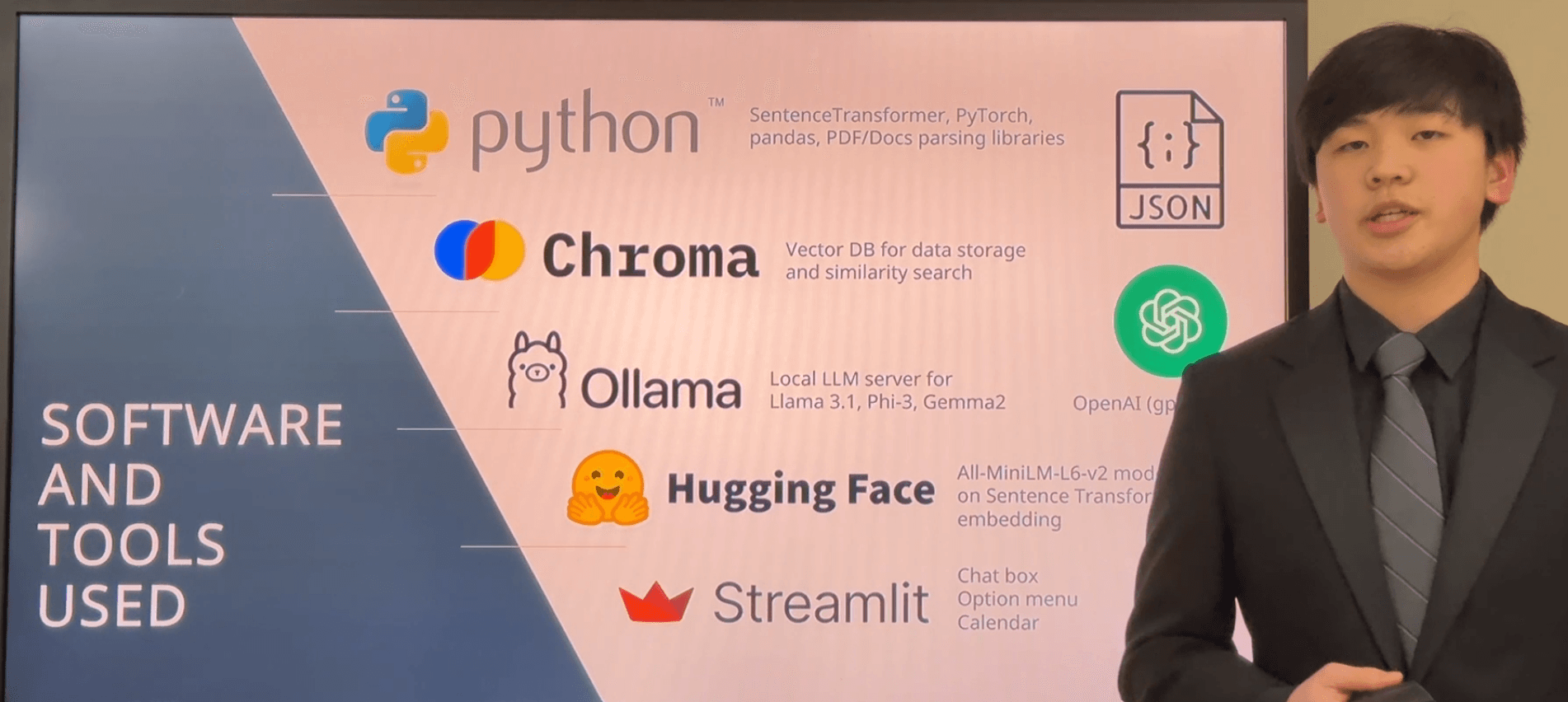
Communicating the system
I presented ParentLensAI as an end-to-end system rather than simply an AI chatbot. The architecture connects document processing, vector retrieval, structured records, local and cloud language models, dashboards, and privacy-conscious data handling.
Explaining the architecture helped me evaluate the platform from both a technical and user perspective: what information enters the system, how it is retrieved, what the model receives, and where human judgment still matters.
Inside the platform
Privacy and responsible design
ParentLensAI was designed with a local-first architecture. Family documents, embeddings, notes, tasks, profile information, and structured records can remain on the user's own computer.
A local Ollama model allows questions to be answered without sending family records to a cloud language model. When the optional OpenAI mode is selected, only the limited text context required for the current question is sent.
The system also treats retrieved documents as reference data rather than trusted instructions, helping reduce the risk that instructions embedded inside uploaded files can alter the assistant's behavior.
What I learned
Building ParentLensAI taught me that a useful AI system is not just a language model. It requires thoughtful information architecture, careful retrieval, privacy decisions, usable interfaces, and a clear understanding of the people the system is meant to support.
Explore the project
The GitHub repository includes the application structure, document processing pipeline, retrieval system, dashboard, trend tracking, and language-model integration.
Source Code and Documentation
Project Collection