Built the connectome
Converted signals from 200 brain regions into 19,900 unique pairwise connectivity features.
Regeneron ISEF Finalist · Computational Biology and Bioinformatics
Using resting-state fMRI and interpretable machine learning, I investigated subtle autism-related patterns in functional brain connectivity and the research-site effects that challenge real-world generalization.
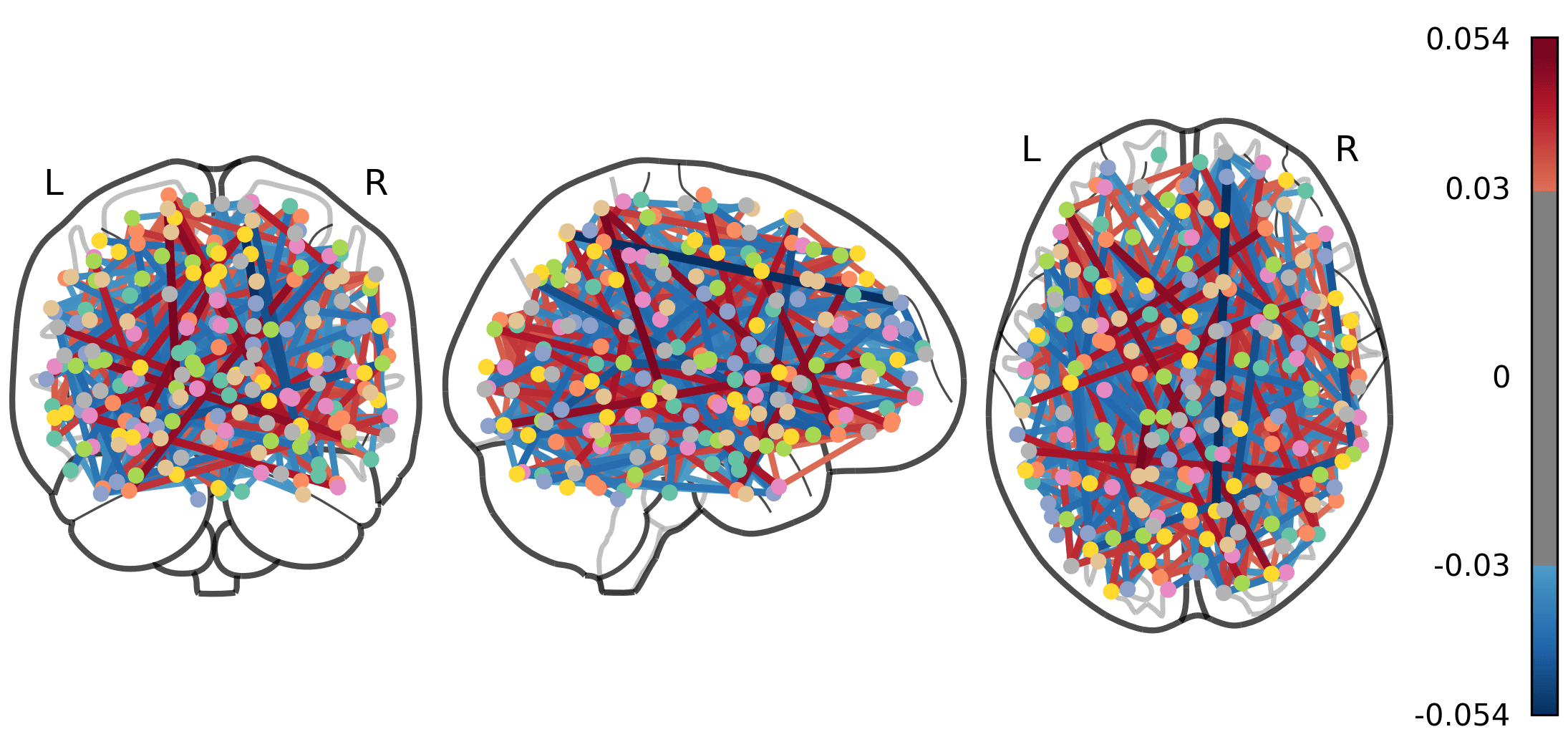
Influential connections were distributed across the entire brain rather than concentrated in one “autism region.”
This project began with my younger brother. During my sophomore year, he experienced a profound regression, yet his clinical MRI showed no structural abnormalities.
I began wondering what differences might exist not in the appearance of the brain, but in how its regions communicate. Resting-state fMRI offered a way to explore that question through functional connectivity, the synchronization of activity between brain regions while a person is at rest.
I built a complete analysis pipeline using public, de-identified neuroimaging data from ABIDE.
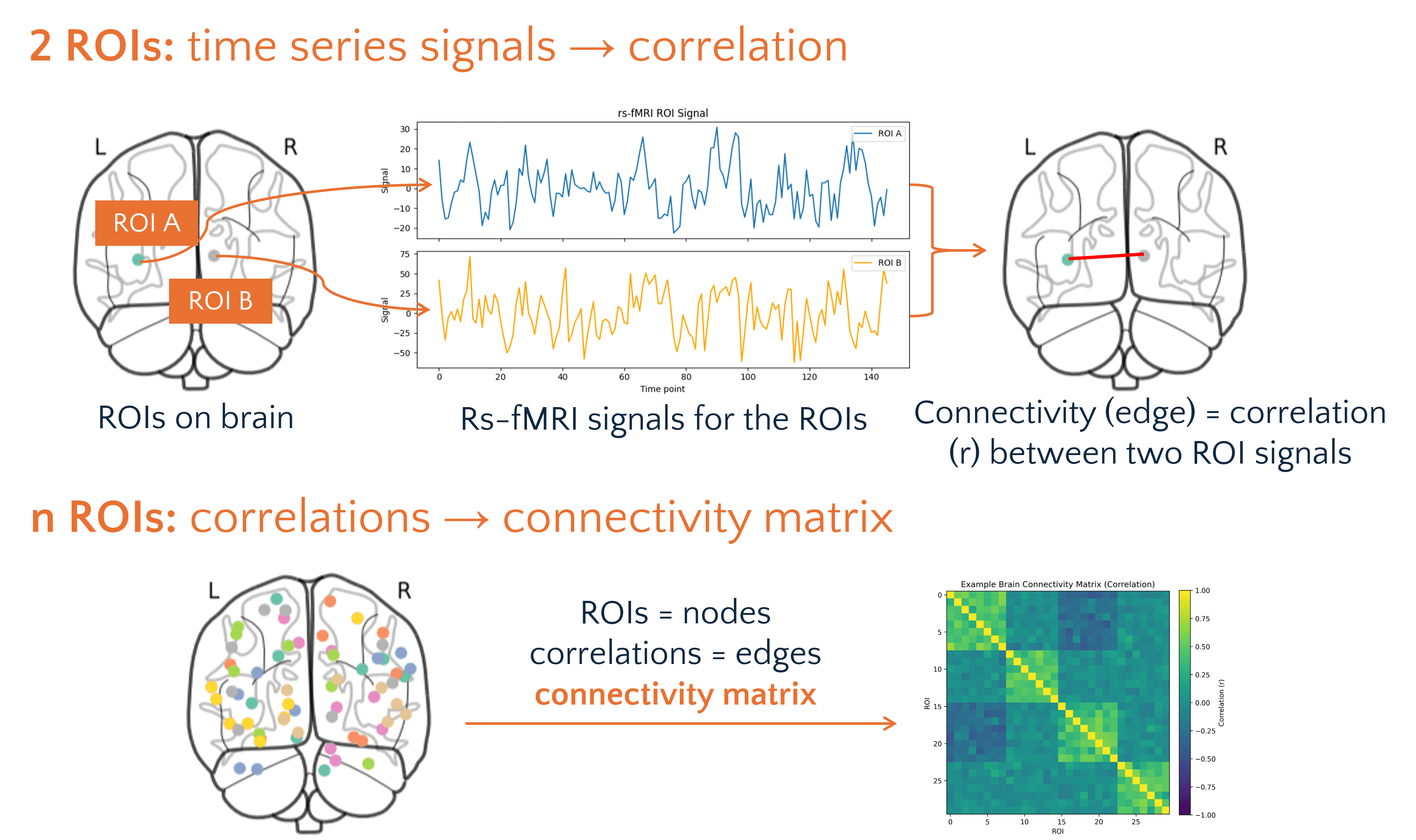
Converted signals from 200 brain regions into 19,900 unique pairwise connectivity features.
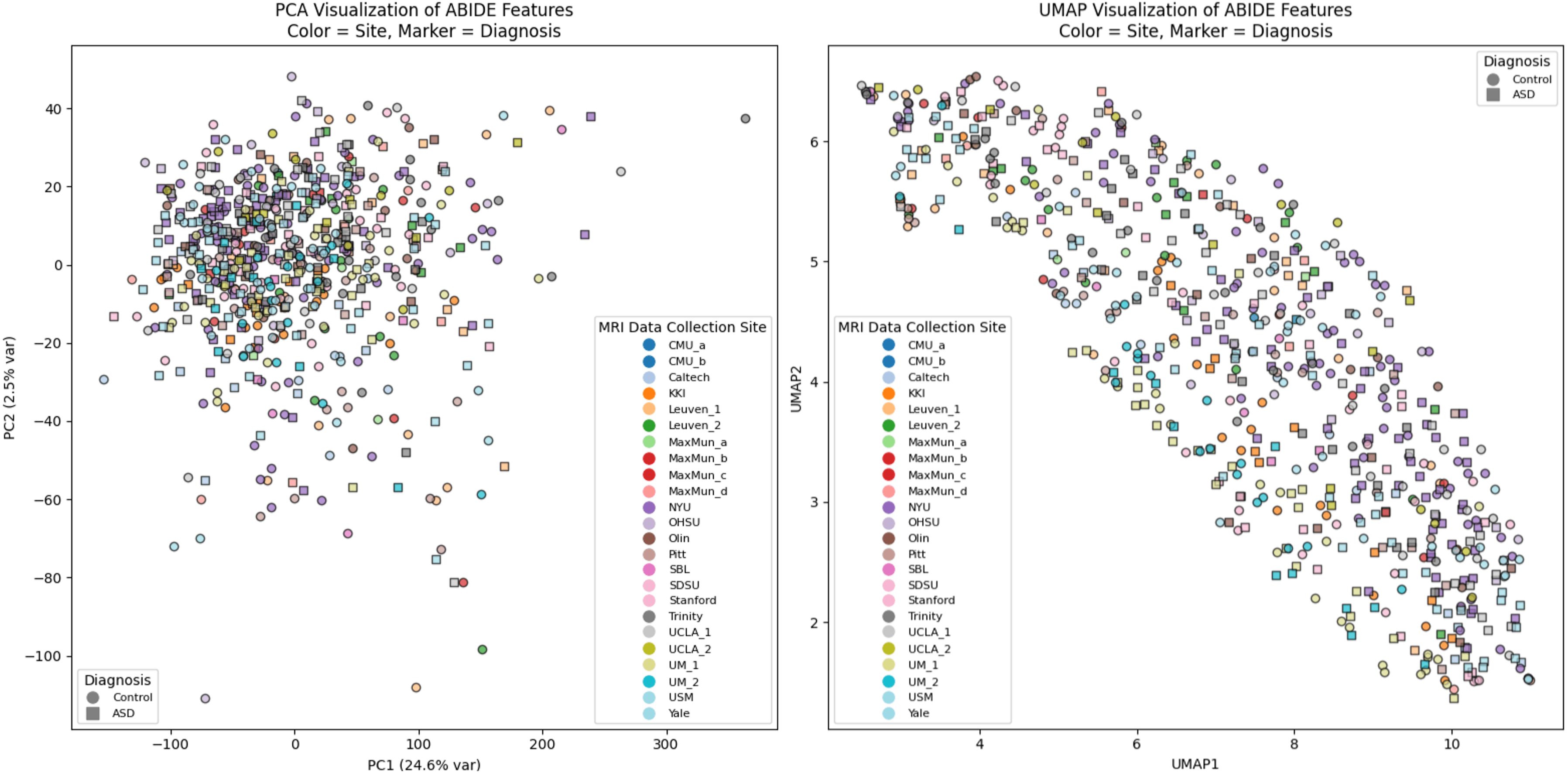
Used PCA and UMAP to examine whether patterns reflected diagnosis or research site.
Trained logistic-regression models and tested each one on an entirely unseen hospital or scanner site.
Used permutation testing, confidence intervals, site-balanced analysis, and model interpretation to evaluate reliability.
Autism-related connectivity differences appeared across many brain-network interactions rather than in one isolated brain region.
Scanner and research-site differences were substantially stronger than diagnosis effects, making strict multisite validation essential.
The model performed significantly above chance on unseen sites, but its accuracy was not sufficient for standalone clinical diagnosis.
The most informative and reproducible connections were centered on interactions between limbic, attention, control, sensory-motor, and default-mode networks, consistent with commonly reported autism-related differences in emotion regulation, sensory processing, and attentional shifting.
What I learned
A model’s accuracy is not enough. You need to ask what information the model might be exploiting, whether the evaluation reflects the real setting, and how uncertainty should shape claims made.
Awards and recognition
International
Regeneron International Science & Engineering Fair
State
Georgia Science & Engineering Fair
Special Award
County
Cobb-Paulding Regional Science Fair
Explore the project
The official ISEF page contains the full project presentation and results. The GitHub repository contains the analysis code, reproducibility materials, figures, and technical documentation.
Official Project Page
Source Code and Documentation